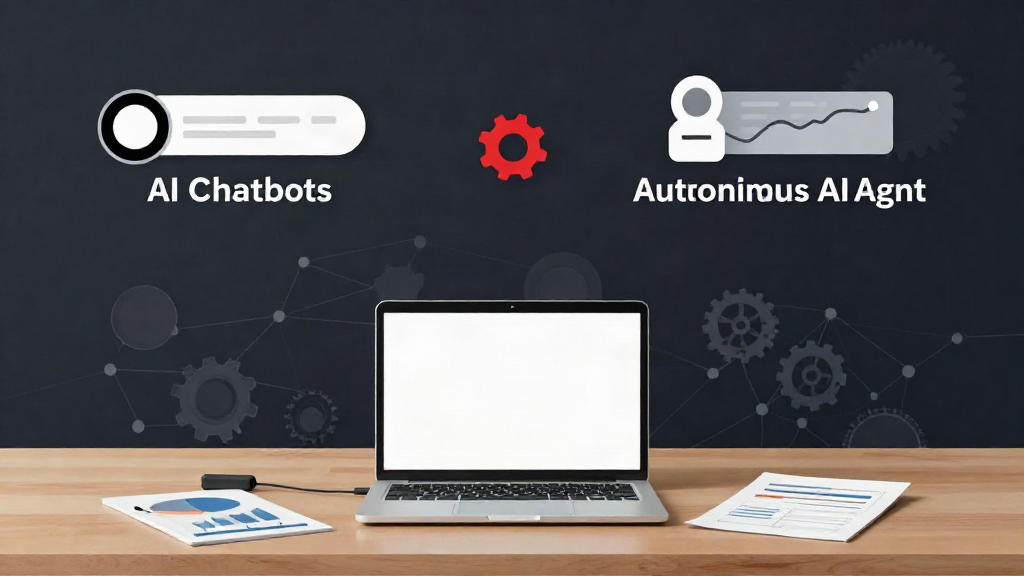
Every few months a new tech word shows up in your inbox, and someone tells you it will change everything. Right now that word is "AI agents." But before you spend a dollar or a weekend on it, it helps to know what you are actually buying. Because "chatbot," "automation," and "AI agent" get used like they mean the same thing. They do not.
Here is the plain-English version: what each one is, what it can do in a real back office, and where it fits in your business.
The three tools, in one line each
A chatbot answers questions. An automation follows a fixed set of steps. An AI agent decides what steps to take, takes them, and keeps going until the job is done.
That last part is the difference that matters. Let's unpack each one.
Chatbots: they talk, they don't do
A chatbot is a conversational front door. You have seen them on websites: a box in the corner that answers "Where is my order?" or "What are your hours?"
What a chatbot does well: it answers common questions fast, works 24/7, and deflects simple requests so a human does not have to.
What it does not do: it does not update your CRM, it does not create a record, it does not trigger anything downstream. When the conversation ends, the work ends. A chatbot is a mouth, not a pair of hands.
If your problem is "customers keep asking the same questions," a chatbot is the right tool. If your problem is "the same data entry happens fifty times a day," a chatbot will not touch it.
Automation: it follows the script
Workflow automation is a set of fixed rules. When event X happens, do step 1, then step 2, then step 3. Think of it as a recipe that never changes.
A classic example: when a new lead fills out a form, automation adds them to your CRM, sends a welcome email, and assigns them to a salesperson. Reliable, predictable, and it runs the same way every single time.
What automation does well: it removes repetitive, rule-based work that never varies. It is cheap, easy to understand, and easy to audit.
Where it breaks: the moment the situation is not in the script. A lead writes "actually I need this for my second location, can you quote me differently?" The automation does not know what to do. It was never told. So the task stalls until a human steps in.
Automation is great at the predictable 80 percent. It is blind to the messy 20 percent.
AI agents: they decide and they act
An AI agent is where the two meet. It can read and understand messy input like a chatbot, and it can take real actions across your systems like an automation - but it decides what to do as it goes, not from a fixed script.
Give an agent a goal: "Keep our CRM records up to date from these incoming emails." Then it reads each email, decides whether it is a new lead, an update, or a duplicate, updates the right record, and flags anything it is not sure about for a human to check. It does not stop at the first step. It closes the loop.
That is the real difference. A chatbot answers. An automation follows a script. An agent owns an outcome.
What an agent can actually do in a back office
For a founder or operator, the useful agents are the ones that close administrative loops:
- Fetching customer or order data from your CRM and ERP and keeping records consistent across both.
- Reading incoming requests, deciding what they are, and routing or updating the right system.
- Triggering cross-platform workflows - updating a spreadsheet, sending a notification, creating a task - and confirming the result.
- Flagging anything uncertain to a person instead of guessing.
The point is not to replace your team. It is to take the repetitive work off their plate so they spend time on the judgment calls only they can make.
The security question you should ask
When a tool can act on its own, the obvious concern is control. That concern is correct, and it should shape how you buy.
Look for three things. First, the agent should be grounded in your own data, not guessing from a general model. Second, it should be built so that anything sensitive stays inside systems you control. Third, you should be able to approve actions before they happen - a human gate on the decisions that matter.
An agent you cannot supervise is not a tool, it is a liability. The right setup gives you autonomy for the routine and approval for the important.
Where to start
You do not need to automate everything at once. Start with one repetitive, high-volume task that follows a clear pattern - the kind of work a person does every day and hates. Map the steps, then decide which tool fits:
- If the task is "answer common questions," use a chatbot.
- If the task is "always do the same three steps," use automation.
- If the task is "understand imperfect input and take real action across your systems," that is an agent.
Most back offices have all three. The skill is knowing which one to reach for.
The bottom line
Chatbots talk, automation follows the script, and agents decide and act. If you are drowning in repetitive administrative work, an agent is the tool that can actually close the loop - provided it is secure, grounded in your data, and built with human approval where it matters.
Start with one task. Measure the result. Then scale what works. That is how you automate without the buzzwords.